
Managing Trailing Cables in Underground and Mining Operations
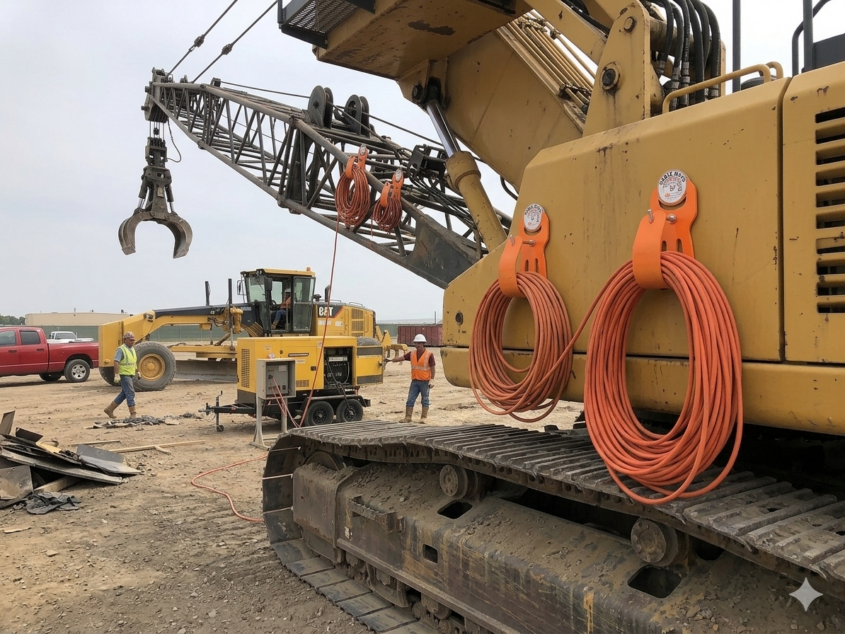
Protect trailing cables and you protect production. A crushed or severed trailing cable stops a machine, pulls an electrician off other work, and in the worst case creates an arc in an atmosphere that cannot tolerate one. Most of that damage is preventable with support discipline and the right hardware.
How trailing cables get destroyed
Underground cable rarely fails from electrical load. It fails mechanically, and the causes repeat across sites.
- Crushed and run-over. Cable left on the floor gets driven over by shuttle cars, LHDs, personnel carriers, and supply trailers. Repeated crushing flattens the conductor, work-hardens strands, and damages insulation long before the cable visibly fails.
- Drag abrasion. Cable dragged across rib, floor, and steel edges wears the outer sheath. Once the sheath is through, water and dust reach the bedding and the screen.
- Tension at the termination. When a machine advances and the cable is not supported, the entire pull load goes to the gland and the reel. Conductors pull out of terminations and the strain relief takes damage that is not visible from outside.
- Water ingress. Cable lying in a wet floor wicks water into any breach. Insulation resistance falls, earth leakage protection trips, and the fault is often intermittent and slow to find.
- Heat and proximity. Cable resting against hot machine surfaces or bunched with other loaded cables runs hotter than rating assumes.
Every one of these is a support problem. Cable that is off the floor, off the rib, and off the machine casing survives.
Why FRAS matters for cable accessories
FRAS stands for Fire Resistant Anti-Static. The requirement is well understood for the cable itself — what gets missed is that every accessory touching that cable sits in the same atmosphere.
A standard polymer clip in a coal environment introduces two risks. It can propagate flame rather than self-extinguish, and it can accumulate static charge in a dusty, high-airflow roadway. In an environment where coal dust and methane are the controlling hazards, neither is acceptable.
The FRAS Cable-Mate (MSAFRCM10) is built for that case. It uses fire retardant anti-static construction to reduce spark and static discharge risk, carries a 55 lb / 25 kg support weight across 6+ cables, and adds a high-visibility yellow strap with a reflective marker so the support point is visible under cap lamp. It is a heavy-duty, high-temperature version of the standard Cable-Mate rather than a different mechanism.
Verify against your own regulatory framework. In Australia and New Zealand, trailing cable and equipment requirements sit under standards including AS/NZS 1802, AS/NZS 2802, and the explosive-atmosphere provisions of AS 2381, alongside your site’s electrical management plan. In the United States, underground coal operations work to MSHA requirements under 30 CFR Part 75, which include specific rules on flame-resistant cable and on how trailing cables and power wires are supported and hung. Confirm the specification with your site electrical engineer before deploying any accessory in a hazardous zone.
Hanging methods compared
| Method | Best for | Limitations |
| Welded hooks and cable brackets | Permanent runs on fixed steel | Hot work permit, cannot be relocated as the face advances |
| Rope slings and cable ties | Fast temporary support | Wear through, degrade in heat and UV, become litter |
| J-hooks on drilled anchors | Fixed roadway runs | Drilling time, fixed spacing, no re-use |
| Monorail and trolley systems | Long high-cycle trailing runs | Capital cost, needs continuous structure |
| Magnetic cable holders | Steel structure, frequently changing routes | Requires ferrous steel, no grip on rock or timber |
Magnetic holders earn their place in one specific situation — where the cable route changes faster than fixed infrastructure can be installed. That describes most of a developing panel.
Where magnetic holders work underground
Anywhere there is clean ferrous steel:
- Arches, sets, and steel roof support
- Rib plates and mesh straps with steel backing
- Conveyor structure, stringers, and drive frames
- Shuttle car and LHD bodies
- Substations, DCBs, and switchgear enclosures
- Steel ventilation ducting frames and stoppings
They do not work on rock, shotcrete, timber, resin bolts, or fibreglass mesh. If a section of roadway has no steel, plan a different support method for that span rather than stretching the interval.
Setting support intervals
Three rules cover most cases.
- Keep sag out of the traffic envelope. Measure to the lowest point of the cable, not to the support. If the lowest point sits inside the machine or personnel envelope, shorten the interval.
- Shorten for heavy cable and long spans. A heavy trailing lead across a wide span loads both the holder and the cable sheath at the support point. Add support rather than accepting the sag.
- Double up at transitions. Put a support each side of a corner, a doorway, a stopping, a change in elevation, or a crossing. Corners are where drag load concentrates.
Also worth building into the standard: never hang a cable so it bears directly on a sharp steel edge, and never use a support to take reel tension. Support holds weight. Strain relief holds pull.
Installation and inspection checklist
Before energising a supported run:
- Steel is clean at each mounting point, free of loose scale and heavy mud
- Cable passes through the strap, not over the magnet body
- Sag at every span clears traffic and standing water
- No cable bears on an edge, weld bead, or hot surface
- Support points visible under cap lamp
- FRAS-rated hardware used throughout any hazardous zone
On routine inspection, walk the run and check for holders that have slid, cable that has worked out of a strap, new water accumulation under a low span, and sheath damage at support points. A holder that has moved is telling you the interval or the surface is wrong.
Frequently Asked Questions
It is designed to release under shock load rather than transmit that load into the cable and the termination. That is a feature underground — the cheap component moves instead of the expensive one tearing.
In non-hazardous underground areas, potentially. In coal, petroleum, or any classified zone, use the FRAS-rated version and confirm it against your site’s electrical management plan.
It makes the support point visible under cap lamp, which reduces the chance of a cable being caught during machine movement and makes inspection walks faster.
No. Fixed hangers remain the right choice for permanent distribution. Magnetic holders cover trailing and temporary cable on routes that change.
Wipe the mounting point clean. Loose scale and packed mud act as an air gap and reduce holding force.