
Cable Buddy, Cable Mate, or FRAS Cable — Choosing a Magnetic Cable Holder
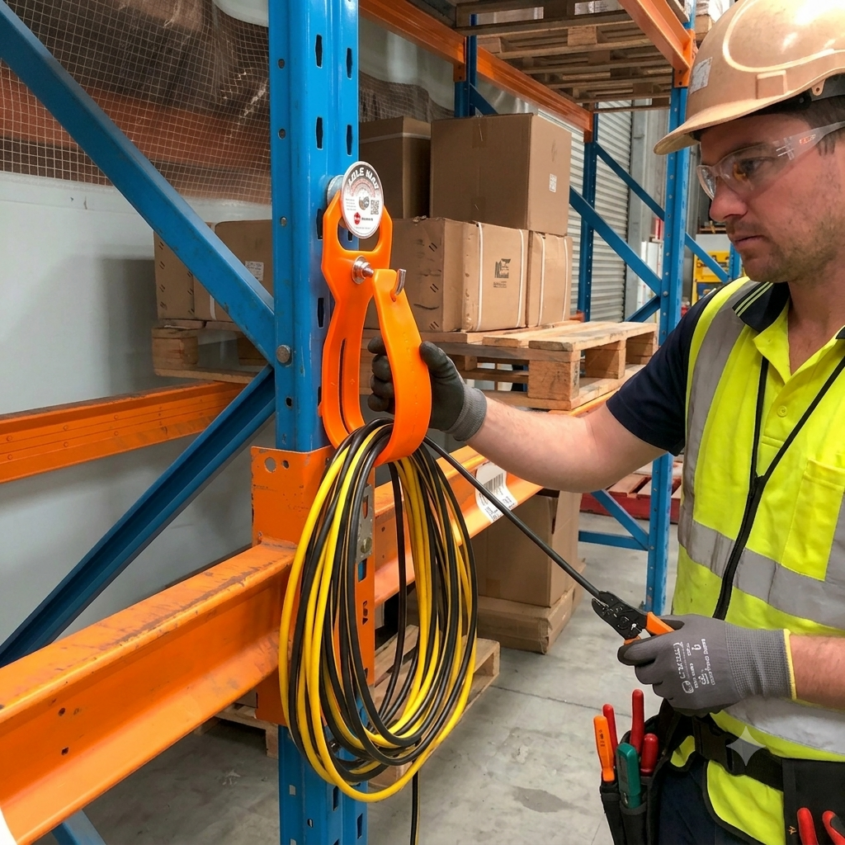
Pick a magnetic cable holder on four variables — how much cable weight it carries, how many cables it retains, what steel it mounts to, and what the environment throws at it. Three products cover almost every industrial cable run, and the differences between them are practical rather than marginal.
Start with the load, not the product
Most specification errors come from counting cables instead of weighing them. A single 4/0 welding lead across a 6 ft span is a heavier hang than four data cables across the same span. Work out the weight of cable between two support points, then choose a holder rated above that figure.
The published support weight is the load the clip or strap will carry, not the force required to pull the magnet off steel.
Hold weight and cable capacity
| Cable-Buddy | Cable-Mate | FRAS Cable-Mate | |
| Part number | MSACB10 | MSACM10 | MSAFRCM10 |
| Cables supported | 3+ | 6+ | 6+ |
| Support weight | 11 lbs / 5 kg (±5%) | 55 lbs / 25 kg (±5%) | 55 lbs / 25 kg (±5%) |
| Dimensions | 1 x 5 in / 30 x 120 mm | 4 x 9 in / 100 x 230 mm | 4 x 9 in / 100 x 230 mm |
| Retention | Quick-acting clip | Adjustable HDPE strap | Adjustable strap, reflective marker |
| Magnet | High-strength rare earth | High-strength rare earth | High-strength rare earth |
| Best for | Light leads, frequent re-routing | Heavy leads and bundles | Mining, petroleum, confined spaces |
The five-fold jump in support weight between the Cable-Buddy and the Cable-Mate is the main branch in the decision. Below roughly 11 lbs the smaller unit is faster to use and less expensive to deploy in quantity. Above it, the strap-style holders are the only option in the range.
Cable diameter and bundle geometry
The Cable-Buddy uses a fixed clip. It suits consistent diameters — extension leads, air lines, single welding leads, patch runs — and it installs fast enough that operators actually use it rather than dropping cable on the floor.
The Cable-Mate and FRAS Cable-Mate use an adjustable strap instead of fixed guides. That matters when the bundle changes: a strap takes six thin control cables today and two thick trailing leads tomorrow without a different part number. If your cable type varies across a site, the strap holders reduce how many SKUs you stock.
Mounting surface
All three need ferrous steel. Structural beams, columns, plant frames, machine housings, shuttle car bodies, conveyor stringers, and steel-framed racks all work. Aluminium, 304 stainless, concrete, timber, and fibreglass do not.
Three surface conditions reduce holding force and are worth checking before a bulk order:
- Coating thickness. Heavy paint, powder coat, or galvanising adds air gap between magnet and steel. Thick coatings can cut grip substantially.
- Curvature. A flat magnet face on a small-diameter pipe or round column contacts on a line rather than a face.
- Surface rust and scale. Loose scale behaves like a coating and can also shear under load.
Where the steel is poor, mount to a clean flat plate rather than fighting the surface.
Environment
This is where the FRAS Cable-Mate separates from the standard version. It carries the same 55 lb support weight and the same footprint, but it is built from Fire Retardant Anti-Static materials to reduce spark and static discharge risk, and it is rated for higher temperature and heavier duty. In underground mining, petroleum handling, and confined spaces, the polymer components of an accessory are exactly the detail an inspector will look at.
For everything else — fabrication shops, construction, warehousing, hospitals, data halls, civil works — the standard Cable-Mate carries the same load without the FRAS specification and cost.
Both are rated for temporary or permanent installation, above or below ground.
Quick selection by site
- Fabrication and welding bays. Cable-Mate for the main leads off the machine, Cable-Buddy for gas lines and grinder leads at the bench.
- Construction and civil. Cable-Mate on steel formwork, columns, and plant. Cable-Buddy on temporary lighting and extension leads.
- Underground and mining. FRAS Cable-Mate throughout. Covered in detail in the trailing cable article.
- Data halls and server rooms. Cable-Buddy on rack frames and cable tray steel for patch and power runs.
- Hospitals, workshops, offices. Cable-Buddy, mounted to door frames, plant, and steel partitions.
Spacing and installation
Support intervals should keep sag clear of walkway and traffic height, and keep cable off wet floor. Shorter intervals on heavier cable. Where a run crosses a doorway or a traffic aisle, add a support each side rather than spanning it.
Two habits worth building into the install:
- Route the cable through the clip or strap, not just over the magnet body. The magnet holds to steel; the clip holds the cable.
- Break the magnet off by sliding it sideways rather than pulling straight out. Shear is far easier than tension and it protects the magnet face.
Frequently Asked Questions
Not reliably. Austenitic grades such as 304 and 316 are largely non-magnetic. Test on your actual substrate before committing.
No. Fixed tray is the right answer for permanent, high-density distribution. Magnetic holders handle the flexible, temporary, and frequently re-routed cable that tray does not cover.
Materials and environmental rating, not capacity. Both hold 55 lbs and take 6+ cables. The FRAS version uses fire retardant anti-static construction for ignition-risk environments.
Physically yes. Check your own segregation rules first — many sites require separation between power and data regardless of the support method.